The Vagabond Hiker

Hiking, trekking, and climbing the world


  • Home
  • About
  • 2025 Calendar

Indochina by boat and foot

February 10, 2017

After all the emotional intensity of Tuol Sleng and the Killing Fields of Choeung Ek near Phnom Penh (see previous post), my Indochina travels at first continued in the same vein, visiting the Cu Chi Tunnels used by the Viet Cong outside of Saigon (now officially Ho Chi Minh City, though natives frequently use its former name) and the pull-no-punches Remnants Museum in that Vietnamese city.  We also visited a local farming and fishing village in the Mekong Delta, at risk from upstream hydroelectric projects in Laos and China.

The Vagabond Hiker in a Cu Chi tunnel, used by the Viet Cong during the American War and enlarged somewhat for the physique of the Western Tourist
Vietnamese lady and sampan
A lizard in the Mekong Delta region south of Saigon

I won’t dwell on my south and central Vietnam excursions in the interesting but touristy town of Hoi An (we were there for the Lunar New Year of Tet), in the beach resort of Nha Thrang, or the industrial city of Hue; suffice it to say that after one week in Cambodia and another in Vietnam observing the lingering effects of the American War, I was more than ready for a return to nature.  A short boat excursion on Ha Long Bay, a two day slow boat trip up the Mekong River from Luang Prabang, Laos to the Thai border, and finally a day spent hiking in the Mae Tang area of northern Thailand, provided the antidote to excess civilization.

Our Explore! group headed out on a morning Junk trip from Ha Long City on Ha Long Bay.  Literally translated as “Descending Dragon Bay,” Ha Long is a UNESCO World Heritage site and perhaps the most-photographed bay in the world; unfortunately, continued gray skies in northeast Vietnam were not ideal for photography.  I think, though, that the photos below do capture a little of the feeling of the bay and its limestone karsts and islets in various shapes and sizes.  The cooks on our Junk conjured up a fantastic lunch buffet; that plus our molto simpatico group made for a superb morning before heading back to the frenetic pace of Hanoi for the following two days.

A local fishing boat on Ha Long Bay
The Vagabond Hiker on the prow of our Junk in Ha Long Bay
View of Ha Long Bay islets from our Junk

Of all the various cities and towns where I spent time during this past month of traveling around Indochina, the lovely northern Laotian town of Luang Prabang on the Mekong River was my favorite.  At the time I was on a hiatus from photography and in any event French architecture and Buddhist temples do not fit with the theme of this blog post.  Even a pleasant 3-hour hike in the northern Laotian jungle between two nearby Hmong villages and featuring a waterfall and lovely pools for swimming did not elicit in me any desire for photography.

That all changed when we left Luang Prabang. There is no better way than to enter or leave Luang Prabang than by slow boat.  That is exactly what we did, taking two full days to make our way up the Mekong to the Thai border at Huay Xai with an intermediate overnight in the hamlet of Pak Beng, Laos.  The trip upstream in the low water of the dry season featured a myriad of minor rapids which we had to navigate around.  We had two tasty lunch buffets on board, a pleasant dinner overlooking the Mekong River in Pak Beng, and plenty of time to chill and watch the world go by.  We stopped at the Tin Tang caves featuring several thousand Buddhas (many more have been stolen) on the first day and at a Hmong village by the river on the second day before arriving at the border town of Huay Xai and transferring to the northern Thailand city of Chiang Rai and thence on to Chiang Mai the following day.

Mekong village just north of Luang Prabang, Laos
A working elephant along the Mekong in Laos
Buddhas in the Tam Ting upper cave along the Mekong in Northern Laos
Our Slow Boat for two days on the Mekong River
View inside our Mekong River Slow Boat
Mekong River bridge in the morning mist
Maggie with two young girls she befriended at a Hmong village along the Mekong

Somehow the temples of Chiang Mai, Thailand held little interest for me during our two-and-one-half day sojourn there, so I once again headed into the jungle.  A fortuitous last minute booking of a full day trek in the Mae Tang Valley north of Chiang Mai, source of the Mae Tang and Ping Rivers, was the perfect solution.  Maggie and I experienced a lush jungle, a waterfall with obligatory swimming hole, cabbage fields, a bat cave, and miles of trails and paths featuring bamboo and wild bananas.  Despite the extensive cultivation and the Hmong villages at the start and end, most of the hike had a distinctly wild feeling to it.

Hike vista, Mae Tang valley, northern Thailand
With Maggie on the Mae Tang hike
Swimming hole on our Mae Tang hike
Cabbage farmers seen on our Mae Tang hike
Valley vista with cultivated bananas on our Mae Tang hike

Sadly, all good things must come to an end.  I am currently in Bangkok and tomorrow will be heading south to Phuket for five days of diving in the Andaman Sea before continuing on to Australia.  If you are interested,  my schedule out to early August is on the “Calendar” tab on the upper right of the home page of this blog site.

My next blog post will likely be from Tasmania.

Happy trails,

The Vagabond Hiker

Asia, Laos, Thailand, Vietnam Kent

Cambodia Impressions

January 24, 2017

Cambodia is a country very much defined by water.  Tonle Sap Lake, the largest freshwater lake in South East Asia, occupies much of the central floodplain in Cambodia.  It swells from under 3000 sq-km at the start of the rainy season in April to 15,000 sq-km or more at the end of the rainy season.  The monsoonal flow increase of the mighty Mekong River causes a unique semi-annual flow reversal to the lake, connected to the Mekong by the 120 km-long Tonle Sap River.

Tonle Sap Lake village on stilts. The lake level rises as much as 10 meters in the wet season.
Tonle Sap village stilt house
Tonle Sap locals getting about
Farmers tilling their fields along Tonle Sap Lake
A floating house on Tonle Sap Lake with satellite dish. Most floating houses are owned by Vietnamese.
A Buddhist pagoda in a village on Tonle Sap Lake. Pagodas are ubiquitous in Cambodia, which is at least 85% Buddhist.

The Khmer civilization was maintained because of the fertility of this region.  The temples of Angkor Wat, Angkor Thom, and Ta Prohm, among many lesser-known ones,  give testament to the preeminence of the Khmer civilization.  There are no ordinary dwellings, houses or other signs of settlement such as cooking utensils, weapons, or clothing usually found at ancient sites.  Only the temples were made of stone and only the temples have survived.

The main temple at Angkor Wat (translated literally it means “City Temple”). It is the largest religious building in the world.
Angkor Wat East entrance bas relief detail
Angkor Wat interior courtyard
An interior courtyard view at Angkor Wat
Angkor Wat monkeys grooming
Angkor Wat from the West (main entrance) side
Angkor Wat West entrance hall bas relief detail
Angkor Thom entrance statues
Angkor Thom bas relief scene of Khmers victorious over the Cham
Angkor Thom view
Angkor Thom four-sided Buddhas
Ta Prohm temple. Aka the Tomb Raider temple for some pop culture reason that I’m unclear about.
Wonderfully overgrown Ta Prohm temple
A strangler fig at Ta Prohm temple complex

Phnom Penh, situated at the confluence of the Tonle Sap River with the mighty Mekong, has been the capital of Cambodia since the French colonial period. (It had intermittently been the capital long before then).  While its faded French architecture hints at prior glory, its modern monuments are an altogether darker sort.  Tuol Sleng, aka S-21, was an infamous detention, interrogation, and torture center used by the brutally evil Khmer Rouge during their 3½ year reign of terror from April 1975 to January 1979.  Of the nearly 20,000 political prisoners who passed through its gates, only seven were alive at liberation, along with four young children.  However, the unspeakable crimes that were committed there were only the precursor to subsequent atrocities.  After confessing to crimes not committed, the men, women, and children were transported 15 km outside Phnom Penh to the Killing Fields of Choeung Ek, a former Chinese burial site.  There they were shot, or more commonly to preserve valuable bullets, bludgeoned to death by hoes, crowbars, or other handy implements.  These mass graves, once filled, were sometimes sprinkled with DDT to reduce the stench, which mercifully accelerated death for those unfortunate enough to be buried while still alive.  More than 120 mass graves exist at Choeung Ek, about 85 of which have been excavated.  After forensic tests, the bones have been placed in a memorial stupa at the site.  Overall, about 3 million out of 8 million inhabitants died during Pol Pot’s reign of terror.

WARNING: at least one of the photos below contains imagery that may be disturbing.

Moonlight Pavilian at the Royal Palace complex, Phnom Penh
A small restored scene from 700 meters of murals at the Phnom Penh Royal Palace
An interrogation room at Tuol Sleng (aka S-21) in Phnom Penh. Twenty thousand political prisoners passed through its torture chambers in the 3 1/2 year rule of the Khmer Rouge. Fewer than one dozen survived. Although photographs inside the buildings were not allowed, I took a few anyway.
Chum Mey’s room in building B of S-21. He is one of only two living adult survivors of S-21.
The Vagabond Hiker with 85 year-old Chum Mey.  He spent 3 months at Tuol Sleng until liberation by the Vietnamese in January 1979.
A mass grave of 100 women and children, mostly naked, at Choeung Ek Killing Fields. The killing tree is on the left.
View inside Choueng Ek memorial pagoda.
Courtyard view in the National Museum in Phnom Penh. repository of many Angkorian artifacts.  The courtyard in its center with Koi pond was a relaxing place for contemplation after an intense day.

The Vagabond Hiker


Asia, Cambodia Kent

A Zion Farewell

January 9, 2017

Observation Point in Zion National Park is one of those rare places that, no matter how amazing the vista, the journey can be even more exhilarating.  Such was the case this past week when I said farewell to my local National Park (everyone should have one).

Although it was perhaps my 10th time hiking the trail up from Weeping Rock, the winter landscape was unlike any I had experienced.  Two friends and I proceeded up the switch-backed path, past the Hidden Canyon turnoff and up through Echo Canyon, quintessential Zion.  The trail quickly became snow-covered and icy as it wound its way up the cliff-side.  Donning our Yaktrax or micro-spikes to provide additional traction on the treacherous trail, we gingerly proceeded upward.  Despite the leaden skies portending snow, it was a magical place.  I hope some of these photos convey a bit of that magic.

Echo Canyon
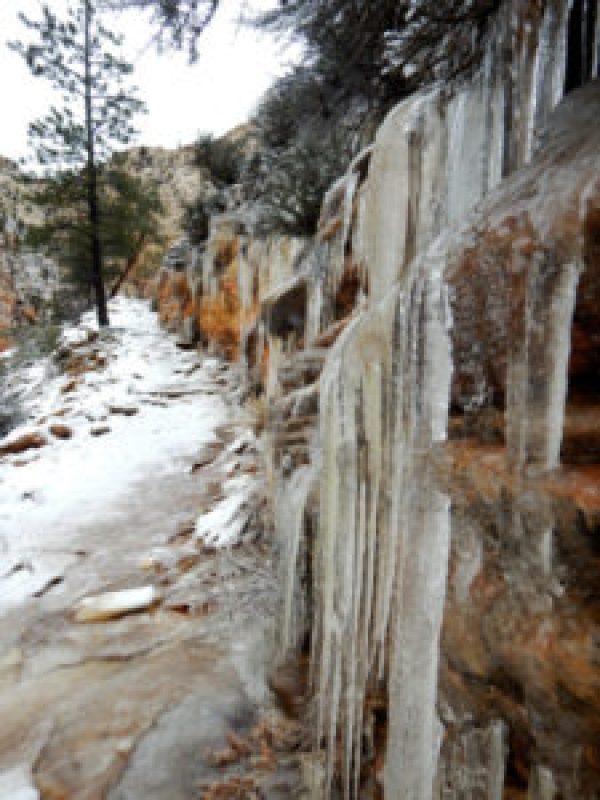
Icicles along Observation Point trail
The Vagabond Hiker on Observation Point trail
Observation Point vista of Zion’s main canyon and Angel’s Landing
The Vagabond Hiker on Observation Point
The West Temple from Pine Creek drainage, Zion NP

Echo Canyon has always been one of my favorite places in Zion.  So much so that I purchased a watercolor Suze Woolf was exhibiting at the St. George Art Museum last year.  Suze is a previous artist-in-residence in Zion National Park [http://suzewoolf-fineart.com/].  Unlike most plein air artists, she often hikes into the back country for her inspiration.  Although now in storage for my upcoming travels, I reproduce her Echo Canyon below for your enjoyment.

Suze Woolf’s Echo Canyon. Watercolor, 2015.

A final apt thought as I pack for my long-term overseas travels is courtesy of Henry Thoreau in his essay “Walking:”

If you are ready to leave father and mother, and brother and sister, and wife and child and friends, and never see them again – if you have paid your debts, and made your will, and settled all your affairs, and are a free man – then you are ready for a walk.

For better or worse, I am ready for a walk.

The Vagabond Hiker

North America, United States Kent

  • « Previous Page
  • 1
  • …
  • 38
  • 39
  • 40
  • 41
  • 42
  • Next Page »

Categories

Subscribe for Updates

Loading

© 2026 ·Journey · by WPStud.io